
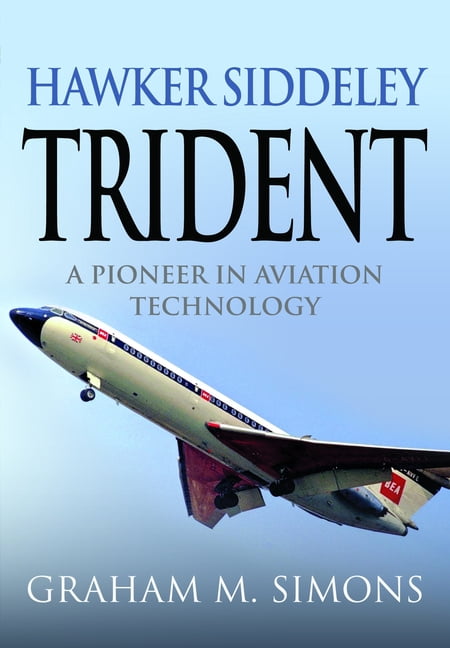
Hawker Siddeley Trident: A Pioneer in Aviation Technology, (Hardcover)
Product details
| Management number | 240078901 | Release Date | 2026/07/16 | List Price | US$21.98 | Model Number | 240078901 | ||
|---|---|---|---|---|---|---|---|---|---|
| Category | |||||||||
<b>Trident pioneers autonomous landing capabilities, showcasing unprecedented speed, reliability, and technological prowess in jet aviation history.</b><br><br>In 1957, de Havilland Aircraft started design studies to meet a British European Airways' (BEA) requirement for a jet airliner capable of &#64258;ying 1,000-mile stage lengths and achieving 600 mph. Then, in 1958, BEA demanded a smaller aircraft, resulting in a major re-design from which the aircraft emerged around three 10,100-pound thrust Rolls-Royce RB.163 Spey engines and seating up to 101 passengers.<br><br>The construction of the first twenty-four aircraft began at Hat&#64257;eld in July 1959. In 1960 de Havilland joined the Hawker Siddeley Group, and in September that year the future airliner's name, Trident, was announced, this having been chosen as a reflection of its then-unique three-jet, triple-hydraulic configuration. Trident took its first flight at Hat&#64257;eld on 9 January 1962. The &#64257;rst revenue earning &#64258;ight followed on 11 March, and full scheduled services on 1 April.<br><br>A pioneer in aviation technology, Trident was built from the outset for automatic landing in bad weather, a feature way ahead of its time. Trident 1C G-ARPB, retained by Hawker Siddeley for 'Auto&#64258;are' and 'Autoland' development, made the world's first fully automatic landing at the Royal Aircraft Establishment, Bedford, on 5 March 1964, a significant milestone in aviation history. The world's first automatic touchdown on a commercial service was made by Trident 1C G-ARPR when it arrived at Heathrow from Paris on 10 June 1965, further demonstrating the Trident's technological prowess and leaving the aviation world in awe.<br><br>The DH.121 was an engineering marvel, boasting several unique features that set it apart from its contemporaries. These included an all-&#64258;ying tailplane, a sideways retracting nose leg offset twenty-four inches to port, and a Bristol Siddeley Artouste auxiliary power unit &#64257;tted under the &#64258;oor of the rear cabin. These innovative design elements made the Trident a standout in the aviation industry, sparking the curiosity of aviation enthusiasts and historians alike.
- Hawker Siddeley Trident: A Pioneer in Aviation Technology, (Hardcover)
- Author: Air World
- ISBN: 9781036193324
- Format: Hardcover
- Publication Date: 2026-11-30
- Page Count: 256
| Book format | Hardcover |
|---|---|
| Fiction/nonfiction | Non-Fiction |
| Genre | History |
| Publication date | November, 2026 |
| Pages | 256 |
| Subgenre | Military |
| Series title | No Series |
| Number in series | 0 |
| Edition | 1 |
| Publisher | Pen & Sword Books |
| Language | English |
| Edu focus | Technology |
| Is collectible | N |
| Binding type | Case Binding |
| Recording time | 0 min |
| Retail packaging | Single Piece |
| Assembled product dimensions (l x w x h) | 6.75 x 6.00 x 9.75 in |
| Assembled product weight | 1.25 lb |
| Bisac subject heading | History |
Bestseller ranking
20th Century Modern History Books






Customers who viewed this product also viewed
Accessories




Correction of product information
If you notice any omissions or errors in the product information on this page, please use the correction request form below.
Correction Request Form